Monday, February 18, 2008

Ancient Greek Theater

So, Saturday was a little on the eccentric side, to say the least.

We all knew that we were going to this theater workshop, something that our tour guide, Vassilis set up because (well, we all assume) that he knew the guy some how. It seems like Vassilis knows everybody in Athens. A few days before we went to this theater we got a packet on how the pronounce the Greek words in one section in the chorus part of Ajax, so we all thought that we were just going to learn how to speak all together and maybe act a little bit; we weren't really sure what to expect, and I don't think our theater teacher, David, really knew what we had gotten ourselves into either.

We walked a long way to this studio that George, our dance teacher/acting coach for the day, rented just for our group. It was kind of in an estchy-sketchy part of town, and the room was really cold. They had three or four propane (I think that's the right word) heaters in the room, but it was still really cold in there. They had us take off our shoes and socks and coats and then we got really chilly. The heaters really didn't do much. One of George's production assistants was video taping the whole thing, and of course Roy, our Religion professor, was taking a bunch of pictures and Vassilis was taking a video part of the time too. Anyway, we knew that we were going to be in this studio for about 5-6 hours, and we were not sure at all what we were going to do for that long of a time.

We started out by standing in a circle, and just breathing together; it was to demonstrate how theater began, and it was really similar to how Gregorian chant and church music started. Everyone started by saying the lines of the chorus all together, and then one person decided to step into the middle of the circle and say some lines by himself and then the chorus would respond. Then all of a sudden, another person got into the middle of the circle too and those two and the chorus would all converse, and apparently this was the beginning of theater! So, we were all standing in a circle, and then George jumped in the middle and started doing a whole bunch of leaps and jumps, and "acting ridiculous." Then he wanted us all to get in the circle one by one and do "something ridiculous" as well. Now, we've been traveling together for 3 weeks or so, enough time to get to know each other a little bit, but not enough time to feel completely at ease with one another. That was pretty uncomfortable for me, to say the least, but, to put it mildly, that was going to be the least of the weirdness for the day.

After that circle exercise, we started vocalizing. First, we all started murmuring and humming and George did this kind of deep groaning thing that was slightly awkward. And then all of sudden he burst into really loud yelling, like a painful sort of agonizing yell. He encouraged us all to yell "until it felt right" to stop, like all of the sadness had been let out of us. Because Ajax was a tragedy, I think he just wanted us all to get into the right mood. Or something. I don't know. We kind of went through the ending scene of the play (eventually, we got the whole thing and put it together, but we had no idea what we were doing at this point in the afternoon). Basically, (George kind of told us bits and pieces and we all had to kind of put it together on our own, so I think that I got a general idea of what happens) something happens to Ajax that involves Odysseus, I'm not sure what, and then Ajax does something bad (I should really know this play) so that Athena tortures him. If he stays in his tent for three days, then he'll be okay and stay sane, but since Athena drives him out of the tent, he goes insane, and yet is completely coherent and finally Athena drives him completely crazy and he kills himself. I think that this is what happens. Anyway. So we were basically the chorus who is under Athena's power and torturing Ajax, driving him crazy. We learned how to laugh rhythmically together (Hahahaha, haha, haha), to enter in a very awkward and strange pose, with our legs spread, knees bent, one arm up in the air and one bent, crossed in front of our torsos. In this position, (get up and try this now) we would hop into the room, just by jumping with our legs and trying not to move our upper bodies at all. We would grunt as we did this (huh! huh! huh!) and then form this pyramid like shape. So, basically, we were doing synchronized grunting and hopping. All 21 of us. As soon as we were all in position, we would stop, put our arms straight up in the air, and then moan/yell until we felt like we should stop and then fall on our knees to the ground. But we shouldn't all stop at the same time. It should be "when the gods move us" or something like that. Then George would come in as this prophet, and he was scary, man. He had his eyes rolled in the back of his head because he was blind (aren't they all) and talking in this really deep voice in ancient Greek, something that even Greek people don't understand. So yeah, that was really really weird. And slightly frightening.

Then we all ran around in a circle, waiting for George, now as Ajax, to enter into it so we could start frightening him. The best part is that we all had this make-up on our faces that was meant to look like masks. And we were all supposed to look dead, like ghouls. We had black underneath our eyes, in the hollows of our cheeks, and then black and white dots all around our mouths. Then we would use our lips to cover our teeth, and had really psychotic expressions and we kind of looked like skulls. I think that was the effect that we were going for. So, we were all running in circles, chasing Ajax, with black and white facepaint making us look dead, after we had rhythmically grunted, laughed, and hopped our way onto the stage for five hours. Now, if that's not a unique Greek experience, I don't know what is. And the guy who was videotaping for all 5 hours, we decided that it was all going to end up on youtube. :)

Saturday, February 16, 2008

Even more pictures!

http://cord.facebook.com/album.php?aid=2030454&l=3b089&id=74602898

Wednesday, February 13, 2008

More Pictures


Greek Dancing
The Head of Zeus


Pottery from museums


One of the earliest examples of funeral statuary, stemming from the Egyptians


Me and Roy on Mars Hill


Museums, Church, and Paul

So, it has been exceptionally busy here. As our professors keep reminding us, this is not a vacation, and lately, it has definately been a whole lot of homework. For those of you who think that semesters abroad are way fun, they totally are . . . but they're a whole lot of work, too!

On Thursday, we went to the Acropolis Museum. There isn’t very much in there, but it was built because Athens did not have a place to store the many pieces of the Parthenon and other ancient buildings that were stolen by Sir Elgin of London. He stole many marble figures from the Parthenon and surrounding areas, and brought them back to the London Museum where they still are. This means that people who go to Athens to see the Parthenon in its entirety (like, say, a class from Concordia) cannot do so. The argument of the brits is that if they had been left on site, more than likely they would have been quite deteriorated if not completely defaced and destroyed. That’s accurate, but what are pieces of the PARTHENON from ATHENS, GREECE doing in the BRITISH MUSEUM???? That really makes no sense at all to me. In response, the people of Athens built this huge building, and are in the process of filling it with archeological pieces they found while excavating, with the hope that someday those darn brits will return the pieces of the Parthenon that were stolen. Dr. Hammerling doesn’t think that this is very likely, but I guess we all can hope. I guess the moral of the story is, if you're ever in London, go to the British museum to see parts of the Parthenon. There is an active excavation going on beneath the building itself, and the floors are see-through, so a really neat part of the museum is that everyone can see the old dwellings, bath houses, aqueducts, stairs, paths, and even things like the tiling on the floors. It’s so awesome. There isn’t very much to the inside yet, but they’re still working on it.

On Friday we had Greek dancing lessons which were totally sweet!!!!!! Dmitris was our dance teacher (a different one than the church one) and we learned some dances from different regions and cultures of Greece. It was so interesting how the people at the dance school had such pride in keeping the tradition of their ancestors and when the dance from their particular region came up to be taught, they made sure to tell us that that was where they were from. He showed us some costumes that people normally wear as everyday clothing. Embroidery and jewelry are supposed to keep away evil, and so women embroider the aprons that they wear to keep their womb protected from evil and curses. I thought that was really interesting. Perhaps they also have embroidery on the back of their coats so that no one can shoot curses at the from behind either. Pretty smart, eh? Most of the dances were done in a circle, with a few steps, seeing as almost everyone in our group were novices; however, our tour guides have been members of this dance group since they were kids.

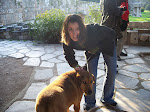
On Sunday we went to this church, (and of course, Rufus, our guard dog that has adopted our group, followed us from the hotel to the church) an Orthodox one that our professor and his wife had found that was actually spoken in English and not Greek, so that we could start to understand parts of the service. However, apparently that church doesn’t have services on Sundays (I didn’t really understand that) so we went to another church. It was a large gorgeous church, and the service was spoken in Greek, and I knew nothing about Greek Orthodox services (still really don’t know much) so I didn’t really know what to expect. I did think that because it was so big that there would be more people in there than there was, and there were only a few chairs, maybe around fifty I guess, and then everyone else was supposed to stand in the back or on the sides. The women sat/stood on the left side of the church, and the men on the right. Since there were many more girls than guys, we all went to the left side of the church. However, we were blocking the Icons. One of the few things I know about Greek orthodoxy is that there are many pictures of saints and Jesus on the walls of the church, called icons, either painted onto the walls or hung paintings of them. The Orthodox faith believes that these icons are windows to heaven; the church is the place where heaven and earth collide and can coexist. The parishioners venerate the icons by kissing them where ever they could reach them. Anyway, on the sides of the church we were all in the way of the icons and did not realize it until a few women came in to venerate them. One of these women grabbed me by the shoulders and just looked at me. To be honest, I was kind of freaked out. I thought that maybe she would be mad at me for some reason, because I was in her way, I don’t know. Anyway, after a while she smiled at me, said something, and kissed my cheeks, said something else. I smiled back and murmured something (I don’t even know what, something between English and Greek), and then she walked away to go sit down. I told my Religion professor, Roy, about this episode later in the week, hoping for some kind of explanation. He said that not only were the paintings of the saints in the church icons, but living people are also viewed as icons, a place where God dwells, and so that was why the woman kissed me; she was venerating me. Anyway, the Orthodox Church has something that is called an iconostasis. It separates the place where the ordinary people can go and the place where only the priests and deacons can go. It is kind of like the Holy of Holies in the Jewish synagogue. In the other churches we’ve visited, these doors have always been closed; however, on Sunday obviously they’d be open so that the priests can walk in and out, so you can kind of see into the priest’s place, which I don’t know the technical term for yet. There was a lot of incense used in the service, which was waved both at the icons on the walls and also the icons of the congregation. There were two choirs up in the front that were kind of doing a chant-like song; I don’t think it was quite a call and response type of thing, but the men and women doing the singing were all dressed in black. They had microphones, but they weren’t really necessary; the singing was quite loud. The message was given from a balcony type thing that jutted out into the church above the people on the left side. It was quite short, and I have no idea what it was about. Of the actual happenings of the service itself, I really do not know what went on; however, we are going to learn about that sometime soon, I hope, and then I will write more on that subject. Also, I think it's worth noting that after an hour in the Church, Rufus was waiting outside for us, to take us back to the hotel. :) These dogs are silly.

One of the coolest things I've done since I've been here is go to a Greek folk concert. It was one of the coolest concerts that I have ever been to, a George Dalaras concert. Look him up. It started off a little shaky for me; there was some quite unfamiliar singing, pitched quite flat and somewhat abrasive and I was thinking, oh man, this is going to be a long night. But it totally picked up after that! Oh, I loved this band so much! It was amazing. There was a violin player, two percussionists (one was in charge of triangle and tambourine only . . . ) and a string bass player, an accordion player, and like, three guitar players and four or five mandolin like players. Also, a string dulcimer like thing that was also pretty cool. The music was, for the most part, upbeat, with asymmetrical meters and quick subdivisions that kept the music flowing, the singers were amazing. Just completely and utterly wonderful. There were two women whose voices I absolutely adored, but also while the band was onstage, it was like there was this play type thing going on in the background, and it was somehow connected to the music, but I'm not exactly sure how. It was all in Greek, so I had no idea what they were saying, but there were images on the back screen of people getting forced out of their homes and the part I could understand the most was when the Nazi flag kept coming on. I think it was mostly about keeping their Greek culture and not letting anybody stop them from singing their songs and doing their dances. I was sitting up in the nose-bleed section, in the third tier of seats (the box seats) but at intermission another girl and I moved down to the main floor, pretty much right where we were sitting before, only two levels down. We got kicked out of some seats at first . . . oops! Upstairs we were sitting in the middle of all these students from the united states, from Moorhead, MN, who had no idea about Greek music. But down on the main floor, the people were all singing along. EVERYONE knew the songs, everyone knew all of the words; at least, that was the way it seemed. One of my professors, David, described it as going to a Rolling Stones concert where everyone there has been a fan for years and knows all the songs and everyone sings along. But it wasn't because everyone was a fan of the band that they knew the words; it was because these songs have real meaning to the Greek people; some of them were banned during the world wars. I guess all I know is that the music tonight was wonderful; and I wish I spoke Greek.

We have also been to a lot of museums. One was the Museum of Cycladic Art, which had some of the first art. Some think that they are symbolic of the mother goddess, though no conclusive clues really point to that. There was also jewelry that was buried with the dead body; they would dig up the bones after the person had been buried for a year and was relatively decomposed, and then put the bones and the jewelry into a bowl type thing. Another was the National Archeological Museum of Athens - there were so many statues in that building. Grave monuments, and steles, and some of them were just pieces of the statuary, not whole statues, because what are they going to do with a monument that they only find pieces of? They can’t really just throw them away. So they tried to reconstrut them to be what they thought that they might have looked like. Agamemnon’s mask was also in this museum, along with more examples of Cycladic art. There were examples of the paintings from Crete (a Greek island that we’ll be traveling to), and ancient things that people used everyday, like potter, tweezers, jewelry, hair decorations, rings, necklaces, and a whole bunch of pottery. We went to the Jewish museum yesterday. The museum was started because after world war two, there were so many artifacts laying around, possessions that Jewish people would never return to claim, that a few Jews decided that they were going to start a museum to protect them and educate people about the Jewish life and culture. It was a seven floor building, but the floors were quite small. There are not many Jews living in Greece anymore, after world war two. All of the communities were shipped off to concentration camps in Germany, the last one three weeks before the camps were liberated. Our guide’s maternal grandparents and her parents lived in concentration camps; her grandparents did not make it out. There was a small floor dedicated to the holocaust, and it was interesting because some of the artifacts on that floor were dedicated to the museum by people who had been in the concentration camps, such as shoes and the work clothes they wore. There were also examples of fake identification cards that the Greek government distributed to Jews through police stations in the cities before the Nazis came to occupy Greece. They used the identity of people who had died, and it was completely legit by the Greek government, identifying them as a religion other than Jewish so they wouldn’t get picked up by the police. Our guide reiterated that the Greeks were generally a peaceful people. Before the full blown occupation, Jews were allowed to be members of groups that were dedicated to Hitler. As our guide put it, “they just didn’t get it.” Jewish children were members of the Hitler youth. They just really didn’t understand what was going on. They also had a lot of information there about the Torah, and they had many cases that displayed it. The Law of Moses always has to be handwritten by the Jews, and the cases that this is kept in are just ornate. They had information on the Jewish holidays, and I was just totally taken back to “Fiddler on the Roof.” They had examples of the clothing that the women wore, and of marriage ceremonies, and Bar and Bat mitzvahs.

Today, after class discussion about Aristotle and Greek gods and heroes, we went up to Mars Hill or the Areopagus, the place where Paul was supposed to have preached in Acts 17 in Athens. Emily, my roommate, read that section of Acts 17 up there, and it was so amazing to hear the words that Paul spoke while in Athens. We ran in to a grad student from North Carolina up there who was doing his dissertation on that particular hill. He told us that that probably wasn’t the place where Paul actually preached, but that the symbolism of the place is more important than the place it self. The Parthenon is on the Acropolis, the center of religion, that was higher up than that hill, and higher than the center of commerce that was at the bottom of the hill. The Areopagus was also the name of a council that was involved with the carrying out of justice in Athens. It was just so cool to see the Bible come to life like that. There are so many names of places in Acts where we'll be traveling to, and before, when I read these passages, it was like they were kind of abstract, kind of out there in space, but we're actually going to be going to places where Paul traveled to, like Thesselonica, Ephesus, and we're already in Athens! Just totally mind blowing.

It rained, and kind of sleeted today! It was weird. And wet. And cold. Although, cold is now becoming relative, because it’s 32 degrees . . . and somehow that’s cold to me. In February. I think I could get used to this . . .

Alicia

Wednesday, February 6, 2008

Picture website

So, I haven't figured out how to upload pictures normally on this yet, so if you want to see some, go to this link (and hopefully it works):
http://cord.facebook.com/album.php?aid=2030204&l=d5325&id=74602898

Love!

FOOD!!!!!! . .. among other things

The food here, for the most part, is pretty great. For breakfast in the hotel, everyday I have an orange (which is usually amazing), but they also have apples, pears (which are also very good), kiwi (ditto). and clementines. They have orange/clementine trees everywhere here, but they are mostly for decoration, as my roommate found out. She tried picking one from the tree to eat, and she said that it really didn't taste very good at all. They also have Greek yogurt, which looks like sour cream (that's what I totally thought it was the first day) but tastes amazing. Some people think that it tastes too bitter, but it also is extremely good with some honey and a cereal that has oats and dried apple bits and raisins, and is really filling. In fact, one night our desert was yogurt with honey. They also have bread in the mornings, with feta cheese and also a sliced goats’ cheese and ham and lox and a spicy venison-like meat and also lamb. Cucumbers and tomatoes are also a part of the breakfast spread, and cookies with chocolate filling (no lie!) and dried apricots and plums and hardboiled and scrambled eggs, bacon, and sausage, and a sweet bread. There is also a food called dolmades, which is grape leaves (real leaves) stuffed with rice, meat and beans. The texture is a little weird, but they really do taste very good. Lunch is on our own, and lately I’ve been having bread and cheese, which is what most of the locals do, if they eat lunch at all. But I’ve also had a gyro, which is shaved pork, lamb, or chicken, with tomatoes, tzatziki (yogurt with cucumbers, dill, salt and pepper, kind of like a dip or sauce), onions, and peppers wrapped in pita bread. It’s so good, but it’s so full of cholesterol it’s ridiculous. The grease just drips out of it. I’ve also had spanakopita, which is spinach pie. It has spinach (obviously) and onion, cheese, and herbs inside of a flaky, pastry-like crust. I also like that, and even though it’s probably not any better for you than the gyro, it makes me feel better knowing there’s spinach in them. J I’ve also had just a normal ham and cheese sandwich wrapped up inside pita bread, a frappee (an iced coffee that’s really popular here . . . I know you can also get them in the US), and . . . bread and olive oil. Also very good. We usually have supper at the hotel, and it’s always a three course event. There is bread and a salad to begin the meal, and then an appetizer, main course, and desert. The salads differ. Last night, it was cucumbers, tomatoes, peppers, and onions with olive oil and some spices, and we’ve had some normal lettuce salads with only olive oil on them, and also some with sliced carrots. Some of the food we’ve had at supper (I can’t keep the appetizers and the main courses straight) have been musaka, a lasagna type dish with eggplant, potatoes, ground meat, and cheese; meatballs with spice in them and fries; spanakopita; large white beans covered in a red sauce; peas, covered in the same red sauce; a pizza type food that had ham and cheese and a different type of crust, more crunchy than chewy, and not really at all like the pizza crust in the US . . . like packed bread crumbs, is the best way I can think to describe it; zucchini, eggplant, and potatoes covered in a sauce; chicken wing with fries (they do try to cater to the American palate occasionally); dolmades with a white cream like sauce; and we’ve had some of these foods more than once. They’re usually very good. And desert has usually been amazing also. We have fruit every other day, but we’ve also had a nut cake (I’m not sure what kind of nuts it was made out of), an apple soaked in wine and the core is filled with walnuts, tiramisu, and last night, we finally had some ice cream covered in chocolate . . . it was amazing. I’ve decided that there’s nothing like topping a Greek meal off in chocolate, but the Greeks have not discovered this yet.

On Sunday, we went for a bike ride around the city at 11:00 am. It was an hour long, and it was pretty fun. It was a really nice day out, but it wasn’t too warm. It was hard to get around everybody in the streets. Sunday morning is a majorly crowded time in Athens; a couple of times we had to get off of our bikes and walk them around people. Another thing: those bike seats had no padding whatsoever, and my butt still seriously hurts from that trip. But, other than not being able to sit for a few hours, it was pretty fun! We were done around lunch time (1:00 pm) and then most us spent the rest of the day doing homework and napping. Later that night (midnight actually) we all headed over to the Athens’ Hard Rock Café to watch the Super Bowl! The Café had it through satellite. The game didn’t start until 1 am, but we had a great time sitting around, watching all of the Americans who have lived in Greece for a few years salivate over their bacon cheeseburgers. The only problem with the game (and the reason that many of us went to watch the game at all) was that there were no commercials! We couldn’t believe it. Instead, they had wide shots of the stadium, which was nice, but not nearly as entertaining. We ended up looking up the funny commercials on youtube anyway, so it really wasn’t that big of a deal. We didn’t get back to the hotel until about 5:30 am or so, and luckily class didn’t start until 1 pm the next day, so we got to sleep in for awhile.
Monday was a busy day, since we only had half of it, and there was a lot of homework due for Tuesday, so most of us spent the day in our hotel rooms, reading “Prometheus Bound” (a story about the god Prometheus who was ordered to be chained to a stone by Zeus because he stole fire from the gods and gave it to the humans) and the Greek Creation story (which is quite different from the Biblical Creation story. If you really want to know what it is, you can find it here: http://www.greekmythology.com/Myths/The_Myths/The_Creation/the_creation.html )

On Tuesday, we discussed the Apology and the Phaedo, two discussions with Socrates, in the places where they actually took place. For the Apology we went to the place in the hills where the senate council met and where Socrates went to defend himself from the accusations of the men of Athens. Obviously, he lost his case and was sentenced to death. The Phaedo takes place on the last day of Socrates’ life in the jail cell where he was condemned until he had to drink the poison that would kill him. There a few places in Athens where it is speculated that Socrates’ prison was (no one is sure) so we went to one place that had three caves right next to each other; it doesn’t take much imagination to see them as jail cells. It was really interesting to see these places that I had read about, never imagining that I'd be able to see them for real some day.

I hope you all are doing wonderfully!! I’m going to try to upload some pictures, but I can’t guarantee that anything will work . . . I love hearing all of your comments; it makes me feel right at home.

Friday, February 1, 2008

A City of Dogs

Have you ever wondered where we get the phrase “It’s a dog’s life” from? Well, if I were a betting girl, I’d wager that the person who coined it lived in Athens. There are SO many mutts just hanging around the city streets that don’t seem to belong to anyone. The weird thing is, everyone I’ve seen has a collar and tags, but we see the same ones hanging out in the same places: near the Acropolis, in the Plaka (the block of restaurants/cafes/shops . . . basically a tourist trap that we’ve gone to pretty much everyday) near the same place, always by themselves. Most of us figure that either the government takes care of their stray dogs or they belong to restaurant owners that just let them wander the streets. The dogs will follow us around for a long time, though. We’ll walk by one of them, they’ll get up from their lazy spot in the sun and just start trotting along. We had one follow us all the way up the hill where the Parthenon is located, which is quite the climb on not so stable terrain. Some of them have been named by different members of the group; my favorites are Pericles and Boris. They also tend to be rather protective, although slightly stupid, dogs. They bark fiercely at anyone that walks past our group; however when our group gets separated and then comes back together, they bark at those guys too. It must be really hard to differentiate.
Ooh!! So, Greece is in the middle of all these fault lines, which I did not know until Tuesday. Anyway I was in my hotel room, working on homework (or . . . on facebook . . . ), and the bed shook just a little bit, so that I thought that someone either upstairs or downstairs had moved something heavy, or (worst case scenario) someone was under my bed, shaking it. Creepy! I just laid there, not really wanting to check under the bed and assuming it was just someone walking heavily or something like that, but luckily, I heard some of the other people in our group talking in the hallway about movement of furniture, so I knew that I wasn’t crazy. We checked the internet later that day, and turns out that there 5.0 magnitude earthquake about 25 miles south of Athens. So, I’ve been in my first earthquake, and I’m still here to tell about it!

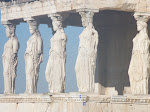
On Wednesday, we walked up to the Parthenon, like actually inside of it. Well, almost inside of it because they had a lot of construction going on, trying to restore it. It had been damaged over the years, pretty much since it was built in 433 bc. However, in 1687, when it had been converted (again) to a mosque, the ottomans decided that it would be a really great idea to store their gunpowder there, to protect their weaponry from the Venitians who were at war with them. However, it turned out to be not such a good idea when it was shot and subsequently exploded. It was really awesome to see the columns though, how they’ve shifted so much and yet are still relied up on to hold up the entire top of them, and are still standing. There were actually three buildings there, the entrance to the Parthenon, known as the Propylaia, and the Parthenon itself, and then a temple, called the Erectheon, where Athena and Posiden had to compete to see who would give the city the best gift. Posiden gave the city the gift of sea water, and Athena gave them the olive tree; obviously Athena won, as the city is named after her.

It was really surreal, seeing the Parthenon. First of all, it’s so old, at least some of the marble is. Way older than anything in the United States; older than the united states, as a matter of fact. Way older. It’s just crazy to see how brilliant the ancient people must have been, to not only create a structure like that with so limited tools and resources, but to do it in such a small time frame also; it was built in only 53 years. It’s something you read about for so, long and then to actually get the chance to see it, up close, and discover things about it that I never knew, like the columns were not just one long shaft, but a bunch of cylinders stacked on top of each other. Also crazy to think that the pieces of marble had to be cut so perfect so that the structure would stand, and the necessary ways of arranging the building so that it would look proportional is slightly ridiculous. They also used no mortar to hold the building together, as this would have promoted deterioration; they relied on perfectly cut marble and gravity. They had to have been so advanced to think of all those precautions to making it look as majestic as they did.

I’m having a great time in Athens, in case you couldn’t tell! I miss everyone at home though; it’s weird to think I’ve been gone less than a week. I don’t miss the snow however, even though the Greek people think that 50 degrees is way to cold to go sit up on the roof of the cafes and have some ice cream . . . they have no idea.